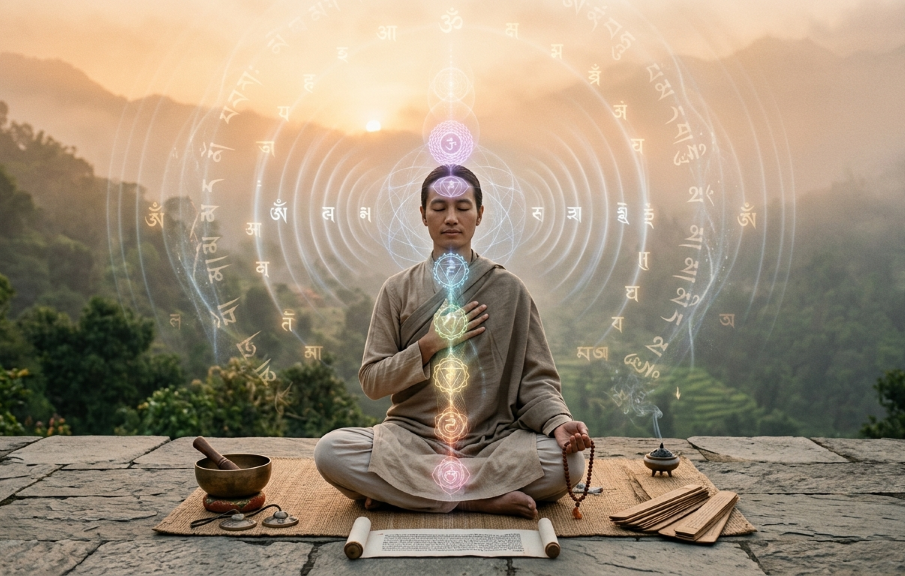
An Ancient Practice of Sacred Sound from the Himalayan Traditions
If you spend any time around meditation halls, yoga studios, or Himalayan monasteries, you will eventually hear it. Someone softly chanting a single sound. Sometimes it is OM. Sometimes it is a shorter syllable like LAM or HUM.
At first it might seem simple. Just a sound repeated again and again.
But according to ancient Hindu and Buddhist traditions, those sounds are not random. They are considered keys that interact with the subtle energy system of the body.
This practice is known as mantra healing.
And while modern wellness culture has rediscovered it recently, the roots go back many centuries into the Himalayan spiritual traditions.
The Ancient Idea Behind Mantra Healing
The concept is surprisingly straightforward.
Ancient yogis believed that the universe itself is built from vibration. Everything moves. Everything resonates.
Sound is simply vibration that we can hear.
Many early scriptures describe how sacred sound can influence the mind, breath, and subtle energy within the body.
The Dhyanabindu Upanishad, one of the Yoga Upanishads, explains meditation on the sacred syllable OM as a path toward inner stillness and realization. The text describes OM as a sound that leads the mind from ordinary awareness into deeper states of consciousness.
Later tantric traditions expanded this idea. The Sat-Chakra-Nirupana, a classical Sanskrit manual on the chakra system, describes specific seed syllables associated with each energy center in the body.
Meanwhile, Buddhist tantric traditions developed similar systems. Texts such as the Hevajra Tantra and the Kalachakra Tantra describe subtle channels and energy centers where sound and visualization can transform ordinary perception into awakened awareness.
Different traditions use slightly different maps. But they all agree on one thing.
Sound can influence consciousness.
What Are Seed Mantras
Seed mantras are short sacred syllables associated with specific chakras.
They are not meant to be translated. Their purpose is vibrational rather than linguistic.
In classical yogic teachings the main chakra sounds are often described as:
LAM for the root center
VAM for the sacral center
RAM for the solar plexus
YAM for the heart
HAM for the throat
OM for the third eye
Silence or OM for the crown
When these sounds are chanted slowly and with awareness, the vibration naturally travels through the body.
Think of it less like singing a song and more like tuning a musical instrument.
Your nervous system happens to be the instrument.
A Simple Mantra Healing Practice
You do not need complex rituals to begin exploring mantra healing. Ancient teachers often emphasized simplicity.
Here is a gentle practice inspired by yogic and tantric traditions.
Find a quiet place where you can sit comfortably. A meditation cushion or chair works just fine.
Take a few slow breaths to settle the body.
Now bring attention to the base of the spine and softly chant the sound LAM.
Let the sound stretch naturally.
Laaaaaam.
Repeat it a few times and notice how the vibration feels in your body.
Then move your attention slightly upward toward the lower abdomen and chant VAM.
Continue gradually through the centers of the body.
RAM at the solar plexus
YAM at the heart
HAM at the throat
OM at the brow center
Take your time. There is no need to rush through the sounds.
If you feel calm and steady, you can finish by sitting quietly for a minute or two and simply observing the breath.
The whole practice can take ten to fifteen minutes.
Why Sound Works So Well for Meditation
One reason mantra practice works well is that the mind likes having something gentle to focus on.
Anyone who has tried silent meditation knows the experience. You sit down, close your eyes, and suddenly your brain decides it is the perfect time to remember every email you forgot to send.
Mantra gives the mind a steady rhythm.
The sound becomes an anchor for attention. Over time the repetition naturally quiets mental chatter.
In tantric traditions the sound is also believed to stimulate subtle energy channels that run along the spine. Whether someone interprets this energetically or psychologically, many practitioners report the same result.
The mind becomes calmer. The breath slows down. Awareness becomes clearer.
A Gentle Note About Learning from Teachers
It is important to mention something here.
Many of the practices described in yogic and Buddhist tantric texts were traditionally taught directly from teacher to student. Some techniques are simple and widely shared. Others require guidance and deeper study.
This article is meant as a general introduction based on information found in ancient scriptures and historical teachings.
For anyone interested in exploring mantra healing seriously, it is always wise to learn from a knowledgeable teacher or guru who understands the traditional context of these practices.
A good teacher can help clarify pronunciation, visualization, and the deeper meaning behind the sounds.
Final Thoughts
Mantra healing is not about performing perfectly. It is about resonance.
A quiet room. A relaxed breath. A single sound repeated with awareness.
Over time that sound becomes more than just a vibration in the air. It becomes a bridge between the body, the mind, and something deeper.
The sages who wrote the Dhyanabindu Upanishad, the Sat-Chakra-Nirupana, the Hevajra Tantra, and the Kalachakra Tantra all pointed toward the same idea.
When sound, breath, and awareness move together, the mind naturally returns to balance.
And sometimes that journey begins with something as simple as one quiet syllable.
OM.
Leave a Reply