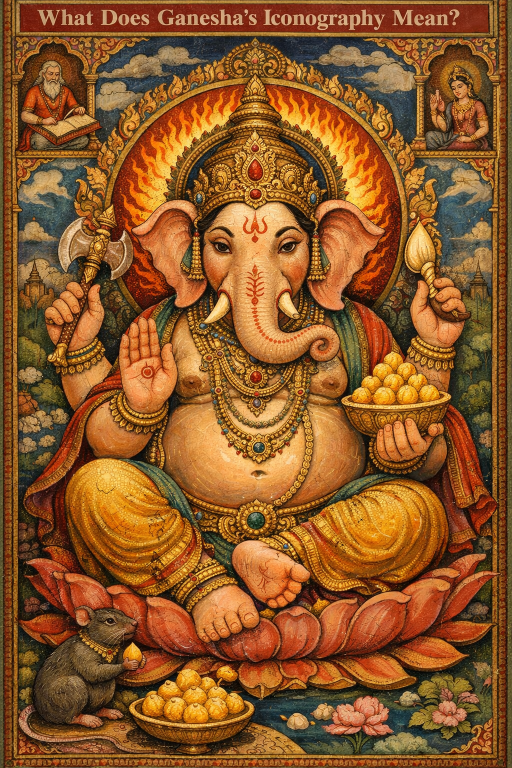
If you are new to Hinduism or Buddhism, one of the first deities you will probably notice is a cheerful figure with an elephant head, a round belly, and a bowl of sweets in his hand.
That is Lord Ganesha.
He looks friendly. He looks unusual. And he shows up everywhere. Temples, yoga studios, home altars, art prints, even keychains.
So who is he really? And why is he so important across traditions?
Let’s unpack Ganesha in a way that makes sense, especially if you are just beginning your journey into Hinduism or Buddhism.
Who Is Lord Ganesha in Hinduism?
In Hinduism, Lord Ganesha is known as the remover of obstacles, the lord of beginnings, and the patron of wisdom and learning.
He is the son of Lord Shiva and Goddess Parvati. One of the most beloved stories about him appears in the Shiva Purana. According to the text, Parvati created Ganesha from sandalwood paste and breathed life into him. When Shiva unknowingly beheaded the boy during a misunderstanding, he later replaced his head with that of an elephant and restored him to life.
In the Shiva Purana, Ganesha is honored with the declaration:
“Tvam eva pratyaksham tattvam asi.”
You alone are the visible form of the Absolute.
This line emphasizes that Ganesha is not just a mythological character. He represents divine consciousness in accessible form.
In the Ganesha Atharvashirsha, a later Upanishadic text devoted entirely to him, we find:
“Om Gam Ganapataye Namah.”
Salutations to the Lord of Hosts.
And more profoundly:
“Tvam muladhara sthitosi nityam.”
You eternally reside in the Muladhara, the root foundation.
This connects Ganesha to the Root Chakra, symbolizing stability, grounding, and the foundation of spiritual growth.
In Hindu practice, Ganesha is traditionally invoked before starting anything important. A business venture, a wedding, a journey, even the writing of a book. Think of him as the divine project manager who clears the path before you step forward.
What Does Ganesha’s Iconography Mean?
Ganesha’s form is symbolic. Every detail tells a story.
The Elephant Head
The elephant represents wisdom, strength, and memory. Elephants remove obstacles in the forest by simply walking through them. The message is clear. True strength is calm and steady.
Also, elephants have large ears. Ganesha listens more than he speaks. A subtle reminder that wisdom begins with listening.
The Large Belly
His round belly symbolizes the ability to peacefully digest all of life’s experiences, good and bad. Spiritually speaking, he can hold the entire universe within himself.
And yes, it also makes him look approachable and joyful.
The Broken Tusk
One of Ganesha’s tusks is broken. According to legend, he broke it off to use as a pen while writing down the epic Mahabharata as Sage Vyasa dictated it.
This symbolizes sacrifice for knowledge and the idea that imperfection does not diminish greatness.
The Mouse
At his feet is a small mouse, known as Mushika. The mouse represents desire. It can sneak into small spaces and cause trouble if unchecked.
By riding the mouse, Ganesha shows mastery over desires rather than being controlled by them.
The Sweets
He often holds a bowl of modaks, sweet dumplings. These symbolize the sweetness of spiritual wisdom. Enlightenment is not dry or severe. It is fulfilling.
Ganesha in Buddhist Traditions
Here is where it gets interesting.
While Ganesha originates in Hinduism, he also appears in certain Buddhist traditions, particularly in Vajrayana Buddhism, which developed in India and later flourished in Tibet and Nepal.
In some Buddhist tantras, such as the Maha Rakta Ganapati Tantra, Ganesha appears as a wealth bestowing and obstacle removing deity. In Tibetan Buddhism, he is often known as Ganapati.
However, the relationship is layered. In some early Buddhist stories, Ganesha appears as a being who is subdued by higher enlightened forces. In later Vajrayana practice, he becomes integrated and respected as a protector and granter of prosperity.
For example, in certain Vajrayana texts, practitioners recite mantras to Ganapati for removing inner and outer obstacles.
This blending shows something important. Traditions evolved in dialogue with each other. Hinduism and Buddhism in ancient India shared philosophical ground and cultural space.
Ganesha became a bridge figure between systems.
What Does Ganesha Represent Spiritually?
For beginners, it helps to simplify.
Ganesha represents:
- Wisdom over impulse
- Grounded strength over aggression
- Humility paired with intelligence
- The courage to begin
In Hindu philosophy, obstacles are not always enemies. Sometimes they are lessons. Ganesha does not magically erase every difficulty. Instead, he removes unnecessary barriers and strengthens your ability to move forward.
In Buddhist contexts, obstacles are often internal. Ignorance, attachment, fear. Ganesha’s symbolic presence reminds practitioners that these can be transformed.
Why So Many People Feel Drawn to Him
There is something disarming about Ganesha.
He looks playful, yet he represents profound metaphysical truth. He is associated with deep philosophy, yet children adore him. He sits comfortably in temples, homes, yoga studios, and meditation spaces.
He does not demand fear. He invites connection.
And for anyone new to Hinduism or Buddhism, that accessibility matters.
A Simple Verse to Reflect On
From the Ganesha Atharvashirsha:
“Tvam buddhi rupam.”
You are the embodiment of wisdom.
That line alone captures his essence.
Not just remover of external obstacles. Remover of confusion. Remover of inner resistance.
A Gentle Closing Thought
If you are exploring Hinduism or Buddhism for the first time, Ganesha is a wonderful place to begin. He represents the starting point. The grounded foundation. The reminder that wisdom and joy can coexist.
And honestly, if spiritual growth had a friendly face, it would probably look like an elephant smiling while holding a bowl of sweets.
Leave a Reply